

7.6 ADDITIONAL QUESTIONS AND ANSWERS
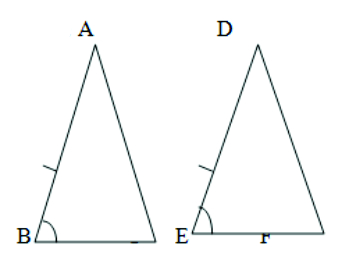
1) State S.A.S congruence rule
Solution:
Two triangles are congruent if two sides and included angle A
of first triangle is equal to two sides and included angle
of second triangle.
Explanation:
Two sides (AB and BC) and included ABC
of first triangle = two sides (DE and EF)
and included DEF of the second triangle.
2) State A.S.A congruence rule
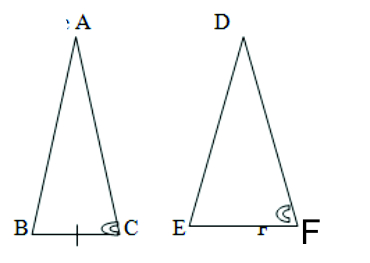
Solution: Two triangles are congruent if two angles and included side A D
of first triangle is equal to two angles and included side
of second triangle.
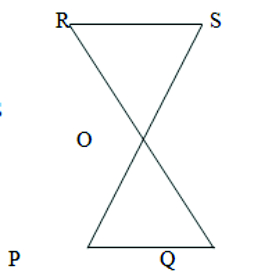
3) Line segment PQ is parallel to another line segment RS. O is the point where QR and PS meet. O is also the mid point for the line PS.
Show that (i) POQ SOR
(ii) O is the midpoint of QR also
Solution:
(i) Consider POQ and SOR
We have PQO = SRO (angle)
(They are alternate interior angles formed as PQ RS
and QR is the transversal)
PQO = SRO (vertically opposite angles)
And OP = OS given (side)
By A.A.S rule we get
POQ SOR
(ii) Since POQ SOR
We get OQ = OR (c.p.c.t)
So O is the mid point of QR
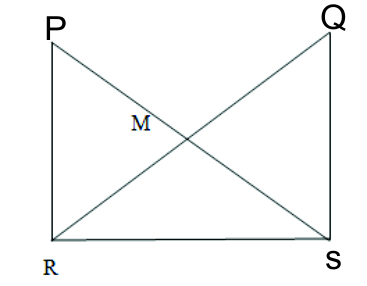
- In right triangle PQR, right angled at R, M is the mid-point of hypotenuse PQ. R is joined to M and produced to a point S. M is the midpoint of line RS. Point S is joined to point Q. Show that: (i) PMR QMS (ii) SQR = 900
Solution:
Proof:
Consider PMR and QMS we have SP
RM = SM (given)
PM = QM (given)
PMR = QMS(vertically opposite angles)
Using S.A.S congruence rule we get
PMR QMS
(ii) We have PMR QMS
We get MPR = MQS (c.p.c.t)Q
R
MPR and MQS are a pair of alternate interior angles
So we get PR QS
QR is the transversal that intersects the two parallel lines PR and QS
QRP + SQR = 1800 (Angles on same side are supplementary)
900 + SQR = 1800 ( QRP = 900)
SQR = 900
- PQR is a triangle in which altitudes QS and RT are equal. Show that (i) PQS PRT (ii) PQ = PR
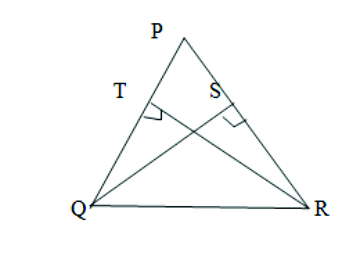
Solution:
Proof: In PQS and PRT we have
PSQ = PTR (each = 900) (angle)
P = P (common angle) (angle)
QS= RT (given) (side)
By A.A.S congruence rule
PQS PRT
(ii) Since PQS PRT
PQ = PR (c.p.c.t)
- QM and RN are two equal altitudes of a triangle PQR. Using RHS congruence rule, prove that the triangle PQR is isosceles.
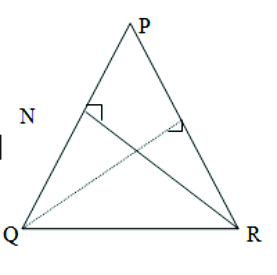
Solution:
Given: QM = RN
To prove: PQ = PR (Hence PQR is an isosceles triangle)
Proof:
We know that QM PR
QMR = 900
Similarly RN PQ
RNQ= 900
Consider the two right angled QMR and RNQ
PQ = PR (given)
QR = QR (common side)
By R.H.S congruence rule
QMR RNQ
(Since the triangles are congruent the corresponding parts are equal)
QRM = RQN
or QRP = RQP (line extended only)
PQ = PR (sides opposite to equal angles of a triangle are equal)
The triangle is isosceles since two sides of a triangle are equal.
7.In Fig. Q < P and R < S. Show that PS < QR.
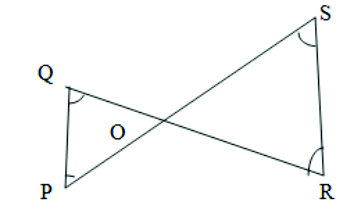
Solution:
Given: Q < P and R< S
To prove: PS<QR
Proof: Q< P (given)
It means P> Q
Side opposite P is OQ
Side opposite Q is OP
OQ>OP ————(1)
Similarly OR>OS ———–(2)
From (1) and (2) we get
[OQ + OR] > [OP + OS]
QR>PS
It means PS <QR (proved)